

Let’s be honest, “academic rigor” is an educational catchphrase that often gets misinterpreted. In staff meetings and curriculum discussions, it’s easy for rigor to be equated with simply making work harder or piling on more assignments. But true rigor doesn’t mean making things tough for the sake of it. Instead, it’s about challenging students to think deeply, reason critically, and become confident, independent learners, with teacher support at every step.
I want to clarify what academic rigor really is and talk about how you can nurture it in your classroom through practical, student-centered strategies.
Whether you’re just starting the journey or looking to deepen your practice, you’ll find clear explanations and actionable ideas designed for educators who want learning to be both challenging and accessible to all.
And if you’re seeking ready-to-use lesson plans, you might find inspiration with my Slam Poetry Unit, Critical Lenses Reading Stations, or Hexagonal Thinking resources, all designed with rigor and engagement in mind.

Rigor Isn’t Just “Hard”: Moving Past the Myths
Let’s address a common misconception right away: academic rigor is not synonymous with “hard.” Just the other day, a well-intentioned colleague voiced concern that a unit and assessment on Their Eyes Were Watching God was confusing rigor with difficulty, suggesting it was “too hard” for students, rather than truly rigorous. This kind of thinking reveals a big misunderstanding.

Real academic rigor isn’t about assigning daunting tasks or overwhelming students. It’s about designing learning experiences that are meaningful, require critical and creative thinking, and challenge students to reach new heights, with the right supports in place. Rigorous work should be accessible, not a barrier. The magic happens when thoughtful scaffolding, intentional classroom design, and responsive formative assessment empower every student to meet high expectations.
Sure, our assessment for Their Eyes Were Watching God is challenging. After reading a complex text, they have to read a complex piece of literary criticism (and understand it), select claims to agree and disagree with, and write a literary analysis essay to support and refute the critic using evidence from TEWWG.
This is a hard assessment, one of the most complex they’ve ever been assigned. But it’s also academically rigorous. Sure, students struggle, but we meet them in that struggle and support them through it. There’s a reason students always name this assessment as one they’re most proud of…because they engaged in thinking and writing in a new way.
Instead of leaving students to struggle, we use scaffolded graphic organizers, peer feedback protocols, and mini conferencing / intentional formative feedback for personalized support.
THIS kind of purposeful planning and teaching is what makes the difference between something that is simply “hard” and something that is “rigorous.” With support, suddenly, those same “hard” tasks become within reach, and students respond with greater confidence and more insightful writing. This shows that academic rigor goes hand-in-hand with thoughtful scaffolding, support, and formative assessment.
Academic Rigor flourishes when you:
- Set High Expectations: Hold the belief that every student can succeed, and communicate that confidence through encouraging feedback and challenging, yet inviting, tasks.
- Provide Robust Support: Use scaffolding, modeling, and differentiated strategies, like graphic organizers or sentence stems, to help students tackle complex work.
- Give Students Ownership: Let students help choose how they learn and demonstrate their thinking, making learning more meaningful and personalized.
- Raise the Bar for Thinking: Encourage analysis, synthesis, and creation (not just recall or surface-level understanding).
As educators, our PLCs play a key role here. When students struggle with a challenging essay or project, we break it into manageable steps, provide timely feedback, and support one another with fresh ideas and resources. Rigorous tasks plus compassionate, flexible support is the winning combination.

Purposeful Complexity: Using Bloom’s and DoK for Academic Rigor
To thoughtfully raise academic rigor, turn to tried-and-true frameworks. Bloom’s Taxonomy guides us through levels of cognitive demand, from simple recall to creation, while Depth of Knowledge (DoK) reminds us to consider complexity, not just content.
- Bloom’s Taxonomy: Build learning from remembering and understanding, all the way up to analyzing, evaluating, and creating.
- DoK: Move beyond basic recall (DoK 1) toward strategic thinking (DoK 3) and extended, synthesized tasks (DoK 4).
Remember: Lower-level tasks aren’t the enemy. They’re the building blocks. Use them to scaffold students’ ascent toward more complex, challenging learning.
Practical Academic Rigor Tip: Start your unit with lower-level activities to build confidence and foundational background, then scaffold upward. For example, when analyzing poetry, you might begin with close reading and analysis of single poems, move to paired text comparison, and culminate with a slam poetry project that asks for synthesis and performance.
Four Practical Strategies to Elevate Academic Rigor
You don’t need to scrap your whole curriculum to make your classroom more rigorous. Try these focused strategies to build both challenge and support:
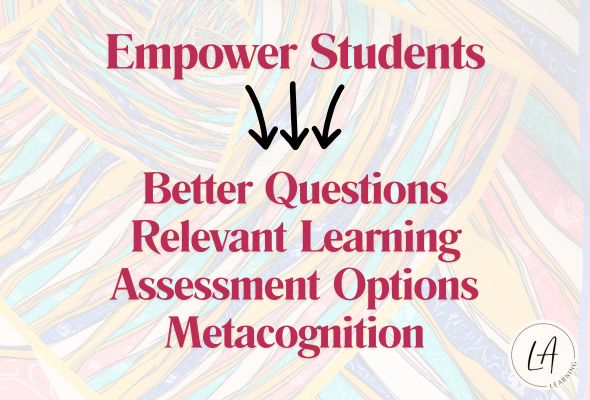
1. Ask Better Questions
The questions you ask shape the level of thinking in your classroom. Instead of “what” questions (simple identification), try “how” or “why” questions that require students to analyze, connect, and reflect.
Transform the quality of discussion and assessments by focusing on how you phrase questions.
- Surface-level: What experience led to Janie’s change in Their Eyes Were Watching God?
- Rigorous: How do societal expectations and values influence Janie’s journey toward self-discovery?
Action Steps:
- Build routines where students generate and revise their own questions. Try the QFT strategy (Question Formulation Technique) to get students involved in forming higher-level questions.
- Provide question stems based on Bloom’s and DoK (e.g., “In what ways…?”, “How might…?”).
- Use peer discussions to model how to “dig deeper,” gradually turning questioning over to students.
2. Provide Academic Rigor Assessment Options
Let students demonstrate understanding in creative, differentiated ways. Rigor shines when students can select assessment formats that play to their strengths but still meet high standards.
One type of assessment doesn’t fit all, and providing choice is key to both engagement and academic rigor.
Let students decide how they’ll show what they know:
- Visuals: Create concept maps or infographics to illustrate complex ideas or themes across texts.
- Debate & Discussion: Participate in bracket debates or fishbowl conversations, analyzing texts in depth.
- Media Projects: Record podcasts or vlogs critiquing themes or perspectives. Have students script and produce a podcast episode critiquing a text from a critical lens, or design a PSA.
- Authentic Writing: Go beyond traditional essays; try editorials or reflective commentaries. Assign vignettes inspired by personal photos, or encourage students to craft slam poems in response to class texts.
Offering options doesn’t lower standards. It raises student ownership and helps every learner shine.
Action Steps:
- Create rubrics with students so criteria are clear and transparent.
- Offer reflection sheets after each assessment so that students can share what they learned and how they might build on it.
3. Scaffold and Encourage Reflection
Rigorous doesn’t mean unreachable. Use clear scaffolds (think graphic organizers, checklists, and modeling) to break complex tasks into approachable steps. Collaborative group work also allows students to learn from each other and share strategies.
Regular reflection is just as important. Invite students to self-assess, track their growth, and set new goals. This metacognitive work turns effort into real, lasting learning.
Examples & Tools:
- Chunk tasks into stages, each with its mini-deadline, so students can focus and get feedback on each part.
- Use graphic organizers for everything from thematic tracking in novels to rhetorical analysis in argument writing. See options like paired text analysis lessons to support close reading.
- Incorporate revision cycles that ask students submit a draft (or part of a draft), receive feedback (either from you or peers), and revise before the final grade.
- Support group work with clear roles and protocols that teach collaboration skills.
Action Steps:
- Open each project with a learning target or “goal-setting” activity.
- End projects with guided self-reflection or peer review, helping students identify growth areas.
4. Make Learning Relevant
Students are hungry for authenticity. Bring the outside world inside the classroom.
Practical Applications:
- Assign students to collect and share current articles, song lyrics, advertisements, or memes that echo or challenge a text’s theme. Guide them to analyze messages using a chosen critical lens (such as feminist or cultural criticism).
- Have students design projects for real audiences: school, community, or even social media to make their analysis matter beyond the classroom.
- Promote project-based learning experiences, such as organizing a class poetry slam or writing op-eds for local publications.
- Let students present findings creatively,to an audience beyond the classroom whenever possible.
These experiences foster a sense of purpose and encourage critical application of knowledge which are big drivers of real rigor.
Building a Culture Where Academic Rigor Thrives
At the end of the day, true academic rigor is a community effort. It flourishes in classrooms where students feel encouraged, supported, and safe to try, fail, and try again. As teachers, when we commit to high expectations paired with practical supports, we create an environment where every student can succeed, not because the work is “hard,” but because it’s meaningful, scaffolded, and within reach.
Educators make the difference when we replace busywork with challenges that are meaningful, scaffolded, and accessible.
Action Steps to Build Culture:
- Celebrate effort as much as achievement—recognize risk-taking, persistence, and creative approaches.
- Use mistake-making as an opportunity for reflection and revision, not for penalization.
- Partner with families and colleagues to keep high expectations visible and to advocate for support systems that benefit all learners.
We owe it to our students to leave “busywork” behind. Instead, let’s aim for classrooms full of challenge, possibility, authentic engagement, and, most of all, growth for every single learner.




 Using Formative Assessment to Drive Student Growth